Friday, March 29, 2013

What lies on the other side of the train tracks

Poverty. It's an ugly reality which most US cities can hide away in a part of town more or less isolated from the rest of the city. Where I'm from, a resident could go years without passing through Newtown, home to most of those who live under the poverty line in the generally wealthy county of Sarasota. Obviously, in bigger cities like New York and Washington, DC, it's a little harder to isolate poverty into one neighborhood, although those cities are working hard at it. In DC, higher rents and higher property demand within the city are pushing those who cannot afford it further and further out of the city into less expensive areas of Maryland and Virginia.

In Buenos Aires, however, one is confronted daily by extreme poverty. Not only does one see tons of homeless people and families sleeping on doorsteps but one also cannot escape seeing the villas miserias (or what we would call slums). Unlike in US cities, these marginalized villas are not separated from the city. There are 21 officially recognized villas spread throughout the city of Buenos Aires and  countless more throughout the province of Buenos Aires. The most famous and perhaps most overwhelming (at least from the perspective of an outsider looking in) is the Villa 31.

Now, I've been on a few mission/service trips to countries in Central America, so I've been exposed to slums and shanty towns before – though I am certainly not claiming to be some sort of expert. I've worked on projects in neighborhoods where people build their homes out of whatever material they can find, where houses are separated by dirt paths covered with garbage, where the sewage/drainage system is composed of ditches dug by residents, and where luxuries like running water and electricity are hard to come by. Most of the homes are single story (for structural reasons) and composed of metal sheets which cover a living space often complete with a dirt floor.

Even with this small bit of previous experience, I can't help but feel overwhelmed each time I see the Villa 31. I'm going to try to describe it, but maybe seeing a picture will help with the visualization. The Villa is certainly not hard to miss since it surrounds a highway which serves a main access point to the city. As one drives by, one sees three, four, five, and even six-story mostly brick buildings which look like square rooms stacked precariously one on top of the other. Many homes only have two walls and a roof so you see right through the family's living space. In order to 'steal' power, cables are strung haphazardly from wires bringing electricity into the city. Within the legally unrecognized Villa there are businesses, restaurants, and hotels; it's almost like a parallel society to the rest of Buenos Aires.

A few buildings in the Villa 31
For me, one of the most shocking aspects of the Villa is its location. It literally borders one of the wealthiest and most expensive neighborhoods of the city, Recoleta. All one has to do to get from Recoleta to the Villa 31 is cross one of the city's poshest avenues, la Avenida del Libertador, walk across the train tracks, and, voilà, welcome to another world. One minute you're walking from designer store to designer store in the upscale shopping center Patio Bullrich and the next you're walking from shack to shack among one of the city's largest shanty towns.

Patio Bullrich: one of Buenos Aires's most expensive shopping malls which lies about 200 meters from the Villa 31
The location of the Villa has led to many confrontations among the politicians of the city as well as the inhabitants of the nearby neighborhoods. Its rapid and uncontrolled expansion has even interfered with the all important bus and train station of Retiro, as some roadways and access points were cut off by illicit construction – not to mention the concerns about violent crime which surround the Villa.

A sky-view of just one part of the Villa 31. (Notice the train tracks separating the villa from the rest of the city)

Since I have not actually entered the Villa myself, nor do I know anybody personally who lives in the Villa 31, I'm not going to comment on the situations of the inhabitants regarding their backgrounds or reasons for living there, but I will comment a little on the massive centralization of Argentina. From what I've gathered from conversations with various Argentine friends and family, one of the main reasons why areas like the Villa 31 exist is the centralization of the country in Buenos Aires. Almost half of the nation's 40 million residents live in Buenos Aires, 15 million in the province and almost 3 million in the city. This massive centralization of population is due in large part to the perception that there is more opportunity and wealth in Buenos Aires than in the rest of the country. Thus, often when people from impoverished backgrounds move to the city with nothing, they settle in a villa miseriaAt this point, I'm not really sure what the government is doing to solve the issue of the villas (especially regarding the safety of the villas' inhabitants who are exposed to major structural risks due to a huge lack of infrastructure and buildings which are certainly not up to code). Last I heard, the city government was trying to begin a massive urbanization project for the villas, but I'm not sure how much progress has been made.

PS. To read more about the Villa 31 here's a great article from the Huffington Post. 

Saturday, March 23, 2013

The confused identity of the Argenyankee and other musings


The idea of nationalities is a weird one. Think about it. We feel pride for a flag which most of us didn’t actually choose. We feel pride for a land that is separated from other lands by more or less arbitrary physical and cultural boundaries. In the US, we are proud to be Americans, but why? We’re proud of the things our nation stands for – freedom, justice, equality, etc – in the case of the United States, yet the grand majority of its citizens were simply born there. Then there are those who immigrated, and while many become well integrated into American society, they are still only part American (French-American, Asian-American, Argentine-American...).

The same applies for immigrants in other countries. Here in Argentina, for example, there are not only many recent immigrants from other Latin American nations such as Bolivia and Peru but there is also a massive population of European descent from the huge waves of immigration in the early twentieth century. Most Argentines who have European ancestors, even those who are third or fourth generation Argentines, still identify with the nation from which their ancestors came – Italy, Spain, France Germany, Poland, etc.

None of us chose our nation of birth nor our ancestry, yet our nationality is something that almost automatically defines us. Consider the stereotypes associated with different countries around the world, many are often even conflicting. America is considered a land of opportunity and wealth, but at the same time in many places around the world Americans are often viewed as ignorant, McDonald's-eating, vicious imperialists. 

There are even self-imposed national stereotypes. In Argentina, a slogan perpetuated by the current president, Cristina Fernández de Kirchner, which appears with every piece of propaganda (television ads, billboards, newspaper announcements...) is "Argentina, un país con buena gente" ("Argentina, a country with good people").  First of all, what does that even mean? Are there not good people in other countries? If Argentina has good people, then why is there so much crime, corruption, and poverty? 


A play on the president's slogan "Argentina, a country with good people (and criminal governors) 

On the other hand, talking to friends and family, Argentines consider themselves to be talented con-artists, more or less. They even say that Argentines don't like to work, are good at taking advantage of the system, and are conceited. And don't even get me started on the stereotypes assigned to the different provinces. Let's just say that porteños generally look down on those from el interior (the interior – a.k.a. not the capital) and vice-versa. 

Recently, with the selection of the new Pope, the Argentine Pope Francis, there has been a surge of national pride among Argentines, even among those who are not Catholic. I guess for a country like Argentina, which does not always make national headlines (except for its extreme financial issues with its debt default and such from the early 2000s), Argentina is relishing its moment in the spotlight. The number of Argentine and Vatican flags hung from apartment balconies throughout the city has surged exponentially since the Pope's election...

People gathered outside a Catholic Church celebrating the election of the Pope (note the flags above...)
These are just a few ideas I've begun to ponder while trying to adapt to a new home in Argentina, trying to strike a balance between maintaining ideas and customs which have always been a part of my life in the States and observing and incorporating new and different concepts from porteño lifestyle and culture. Also, the issue of communicating in a second language, even one in which I'm basically fluent, is a struggle I'll save for another post.

*Side note about the game between Argentina and Venezuela from last night: One of the clearest modern manifestations of nationalism, in my opinion at least, is international sports competition such as the Olympics or World Cup. Last night, I was blessed enough to witness it for myself at River Plate's Monumental Stadium which played host to a World Cup Qualifier match between Argentina and Venezuela. (I won't tell you exactly how I got in to the game, but let's just say I didn't have a ticket and playing for River Plate has its perks). The atmosphere of the fans was completely different from when I saw River Plate play. When the national team plays, the fans are mostly quiet, clapping when the Argentine players do well, booing and whistling when the other team does well, and screaming and cheering when Argentina scores. There wasn't the constant standing, jumping, singing, and chanting like when Argentinian clubs play each other. Honestly, I think a lot of Argentine soccer fans feel more pride for their club than for their national team... It was also quite strange to see the Monumental filled with fans dressed in light blue and white (the colors of the Argentine flag) instead of River's red and white. It was interesting though to see fans of so many rival clubs, who might normally be separated by fences and barbed wire at an Argentine league match, all cheering for the same team.

Argentina preparing for a corner kick in the second half (Messi is in the picture somewhere...)

I have to say, even though I wasn't born here in Argentina, it's really easy to feel proud of a national team like the one I saw play last night. Holy moly, Argentina's roster is filled with some of the best players in the world: Messi, Higuain, Mascherano, etc, etc. Those guys are incredible. The way they move the ball around the field and the calmness with which they maintain possession is unbelievable. And then there's Messi. What can you even say about Messi? His teammates would pass him the ball in a situation in which he was already marked by multiple defenders and somehow he would manage to get out and make something positive happen for his team. I'm pretty positive the audience unanimously voted Messi "man of the match" (two beautiful assists and a goal from a penalty kick he earned), something I gathered from everybody chanting "Olé, olé, olé.... Messi!!! Messi!!!"each time he would touch the ball... Watch out Brazil 2014. Messi and Argentina are coming to win it all.

Wednesday, March 13, 2013

La movida porteña (porteño/a = an adjective applying to anything related to the city of Buenos Aires)


Friday night (or Saturday morning...) 4 am. Sitting in a bar in San Isidro, a town just north of the capital, just off a main avenue, relaxing on mismatched, antique (or perhaps more accurately described as old and unwanted) furniture, surrounded by modern, eclectic pieces of art, and listening to an impromptu samba concert.

It all started at a restaurant in Belgrano, a neighborhood within the capital, where I met up with a friend, we'll call her "N," and spent about 3 hours just talking and catching up with her. After midnight, when the restaurant was starting to close, we decided to go meet up with some of N's friends at a bar in San Isidro that they had just found (it was so tucked away that even the guys who had lived their entire lives in the area didn't know it existed until that night).

Even waiting for the bus to go to the bar was an adventure. I was at the point of just going home because we were waiting so long.  It seemed like every bus except for the one we needed went by. Finally, we decided we'd go only if the next bus that came was ours. Thankfully, it was.

We got off the bus after about thirty minutes and walked up to a bar/restaurant which appeared as though it was already closed except the door was wide open. N led me in despite the darkness, and the place was packed. Only upon entering did we learn that the power had just gone out, as we saw the staff was scrambling to find candles to give a little light to the otherwise pitch black tavern. N and I found our way to a table using our cell phones as flashlights, but shortly after we sat down, N's friend called to tell us that they were actually at a different bar, one that was only a few blocks away. We quickly thanked the waitress as we left the dark tavern and started heading toward the other bar along the town's main avenue.

Our only light at the first tavern

When we first arrived at the bar, one of the guys led us around the back of the bar to an outdoor patio area where the rest of the group was sitting, around a fire pit, which at that point was letting off more smoke than flame... I wish I had been able to take a picture of the outdoor space. Spread throughout the space were all kinds of interesting modern sculptures and light fixtures that lit up tables filled with friends enjoying each other's company. At one point, probably around 3:30 am, one of the guys went inside to go to the bathroom – and never came back. N and another friend went in to check on him, leaving me with only two others at the table. After about fifteen minutes, N came back out and told me I had to go inside with her. What she showed me was something unlike anything I'd ever witnessed before, something very unique to a city like Buenos Aires.


On the cello was an overweight, African-Brazilian woman singing samba beautifully with a deep, raspy voice.
The rest of those accompanying her were an odd blend of strangers united only by the music they created together. A young man from our group playing the bongo drums, an older porteño playing the piano beautifully, and another middle-aged brazilian woman singing harmony and playing various types of percussion.

Just one room of the musical/artistic bar


Sitting there listening to the mishmash of musicians trying different combinations of rhythms and melodies, some with success and others with failure, made me think of what it might have been like when the famous Argentine tango was birthed in Buenos Aires about a century ago... a mélange of immigrants from Europe and Africa who would gather randomly at bars late at night in the city to play music and sing together, experimenting and collaborating and inspiring those listening to dance what is now (in my humble opinion) one of the most seductive and intimate dances that exists, el tango.

Finally, around 5 am, the band started to disassemble, and the remaining patrons began to leave (myself and N included). N called a remis, basically a taxi except cheaper and safer, and we rode home to her house to stay there for the rest of the night (a.k.a. morning...). The next day, Saturday, I spent all afternoon lounging by the pool at a friend's house in San Isidro. I have to include a picture of her dog because he is so cute (and huge).

Rocco, the star of the afternoon
Sunday was another epic day. (what kind of post would this be if I didn't mention fútbol??) It was my first experience at a professional men's soccer match in Argentina. Now, I've been to a couple of pro games in other countries. I've been lucky enough to have gone to US international men's and women's games, an MLS game, and even a French Ligue 1 match in Paris, but none of those experiences come close to the thrill of standing and cheering among the hinchada (the faithful) of River Plate in the Monumental.

Even though I go to River Plate every day for training, finding our way to the entrance was tricky on game day. In order to avoid violent clashes between the visiting and local barras bravas (if you don't know what that means, you should definitely read the hyperlinked article), the metropolitan police block off entire streets and specifically designate which fans can access the stadium by which routes – and this game wasn't even against one of River's main rivals. The barra has one entrance in the back of the stadium which is isolated from the average fans (so Mom and Dad, don't worry, I wasn't sitting among the crazy ultras who always end up in the news for fighting with other fans). Luckily, since my friends and I are women and none of us wore a River jersey until we were at the stadium, the police let us walk cut through the visitors' path in order to avoid having to take a loooooong detour to get to the club. For further security and safety precautions, on the street in front of the stadium, the police have a blockade set up where fans have to show their ticket and undergo a pat down in order to get to the entrance. My friends and I made it through without any issues, but as we waited to go in, we saw several fans get pulled aside by police to have various drugs confiscated (although I think afterward they were allowed to enter the stadium anyway, but I'm not sure...). We faced a similar sort of security checkpoint as we went through the stadium gates (pat down and purse check), and then we made our way to our seats (which we never actually used...).

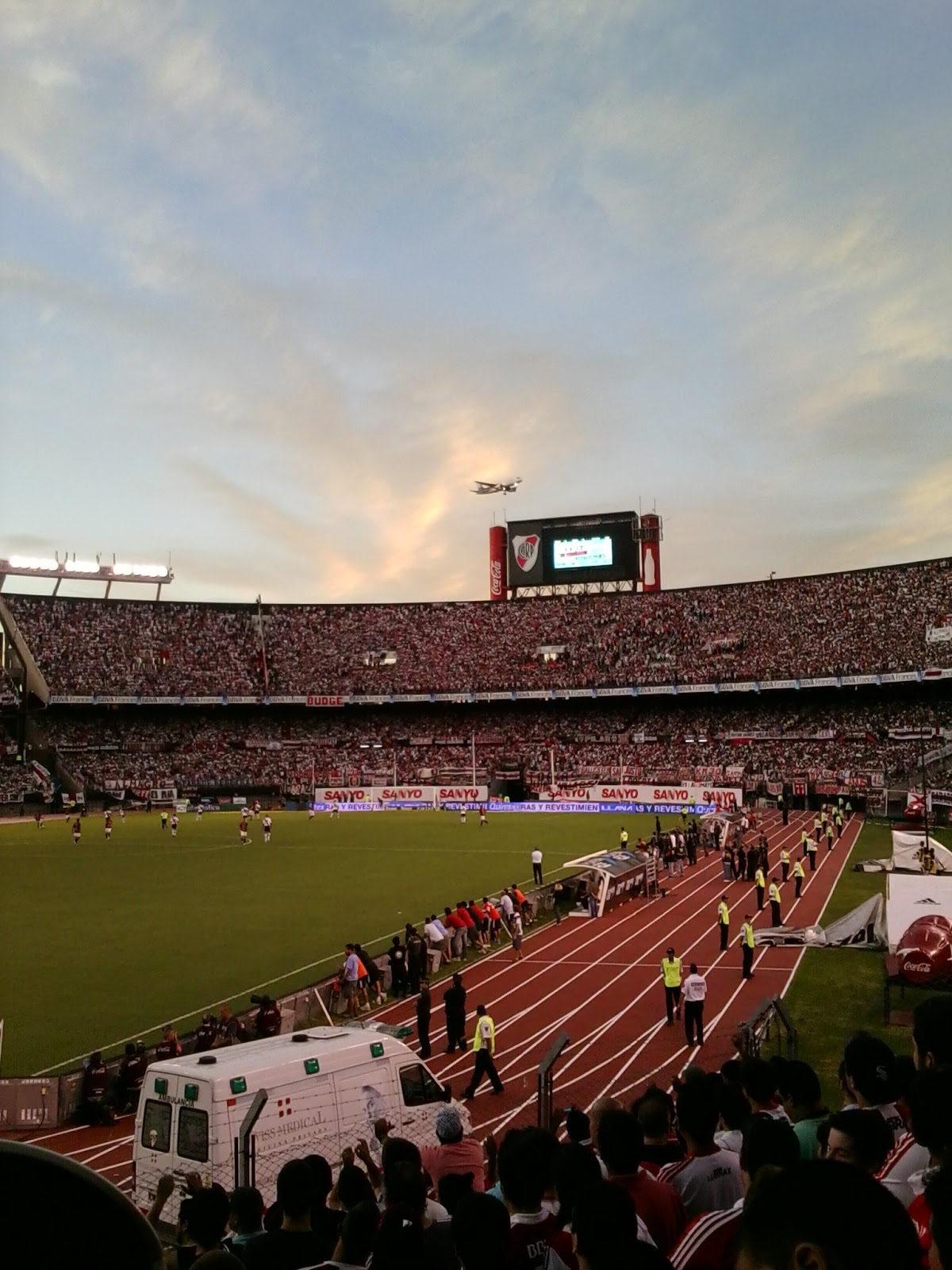
A beautiful night at the Monumental. Soccer, sunset, and planes landing at the airport nearby.

Before the game even began, as the starting players were waiting on the field for the whistle to blow, the fans began to sing, led by the drums and chants of the barra in the upper deck at the far end of the stadium below the scoreboard. I can't even begin to describe how awesome it is to be among more than 60,000 people all dressed in River's red and white, singing, clapping, and yelling for almost the entire 90 minutes of the match. The only time the crowd was quiet was for a couple of brief seconds when the away team, Colón of Santa Fe, cut River's two-goal lead in half with about fifteen minutes to go. But after that brief silence, the crowd began to sing even louder, urging on its beloved team for the rest of the match. At the end, after the referee had blown the final whistle, the crowd began to sing even louder than before, especially as the players made their way around the field applauding the fans for their support. The home fans then had to wait about a half hour until all of the visiting supporters had left the stadium and had been loaded onto the buses for the long drive back to Santa Fe. In order to avoid the mass exodus of fans via public transport immediately after the game, we went to the cafeteria to sit with the girls on the team who had to eat dinner at the club. It worked out perfectly because by the time they finished, the majority of fans had already cleared out and we had no problem getting on the subway to go home.

Needless to say, it was an amazing evening, and I'm definitely going to all the home games that I can make it to. Also, any of my friends who come to visit me will also be highly encouraged to come with me to a match. It is an unforgettable experience that is unique to soccer in Argentina and so unbelievably different from sporting events in the United States (in both positive and negative ways).

Monday, March 4, 2013

Love and soccer


Going by my last post, I'm concerned I might have come across overly negative towards women's soccer in Argentina, which would be a very unfair assessment. Unfair not only to all of the girls and women who play but also unfair to all of the coaches, administrators, equipment managers, doctors, etc who donate their time and efforts to women's teams throughout the nation. While there are certainly aspects of Argentine women's soccer that I would love to improve, there are so many more things that I love about playing here that I never experienced during my time playing in the United States.

Team picture in River Plate's Stadium, El Monumental

I love how every time our team gets together, whether it's for training, a game, a trip, or a meal, we always greet and say goodbye to each teammate individually with a kiss on the cheek. Granted, it does take time to go around the locker room and say hello to every single person in there, especially when I'm the last one to arrive, but it is amazing how a simple greeting has made me feel welcome among a group of people I hardly know. In the United States, when I would come to team events, I would usually just say hello to the group in general and maybe give a hug to a few of my closer friends, and only if I had not seen them in a while. To an American, greeting someone with a kiss on the cheek can seem overly intimate, especially when we are so accustomed to handshakes, but I think a kiss breaks down relational barriers in a way a handshake cannot and allows for friendships to grow more quickly and on a deeper level (but I may be overanalyzing the situation...).

I love how much each player loves fútbol. Many are willing to spend 3 hours or more traveling just to train for 2. (I know I've mentioned this before, but it still amazes me when I talk to the girls about their commute.) There is nothing forcing them to continue playing, no monetary benefits, no pressure from family, no fancy sporting gear, just love. Love for the game. Love for her team. Love for her coaches, her club, her country. Although I loved soccer before, since joining River, my love for the game itself has really been reignited. In college I often found myself dreading practices, games, and weight training because I always felt a huge amount of pressure from coaches to perform. Winning was always the goal, no matter what the cost, whether it meant sacrificing relationships, stirring up competitive strife between teammates, or even ignoring players entirely. And if that wasn't the case, then it is certainly the impression I came away with after playing at two different universities under three different head coaches. Obviously, winning is still important in Argentina, and the ultimate goal is to get results on the field – but not at all costs. The coaches and staff at River strive to make us not only better players but better people. Because, in the end, soccer is a game that we can only play for a relatively short part of our lives, but the lessons of teamwork, relationships, hard-work, commitment, etc that we learn from the sport will stay with us in whatever we do for the rest of our lives.

I love how everybody shares everything with everyone. Whenever somebody buys a drink or a snack and is around the team, before even taking a sip or a bite, the first thing she does is offer it to the girls who are standing nearby. This was something that took a little getting used to for me – I'm not going to lie. To be honest, I'm still adjusting to the whole sharing-your-water-with-everybody-thing. I would not consider myself a "germophobe" per-se, but enough so to where I'm slightly wary of drinking from the same bottle as 20 other girls. Granted, one usually only shares with a few others, but still the idea is one that takes some getting used to. Nonetheless, as a new member of the team, one cannot help but feel welcomed and accepted when a teammate offers to share her snack. It's a small gesture that goes a long way.

I could go on about what I love about playing here, but I think I can help sum it up by telling about our team's trip last weekend (Feb. 23-24), which I will describe in my next post since this is one is quickly getting too long...

Thursday, February 14, 2013

Hot, Sweaty, and Humbled: My first game in Argentina

This past Monday I had my first real taste of women's soccer in Argentina. My pride wishes I could tell you it was filled with glory and screaming fans and a beautiful stadium and nice gear and top competition and other equally wonderful things, but I can't. It was not at all a negative experience, but it was, however, a humbling one.


Both teams after the game

Even though this is not my first time playing soccer, or fútbol, here, when I trained with the national team (la Selección) in 2011, I was still in a kind of bubble. La Selección  was the highest level of women's soccer this nation has to offer, so the equipment, facilities, and quality of the players were not so different from the States'. What struck me the most during my first experience playing in Argentina was how far each player had to travel to get to and from practice every day.

Each afternoon before practice, the players would meet at a hotel in Belgrano, a neighborhood in the capital, to take a bus to the training complex which lies about an hour outside  the heart of the city. For those who are unfamiliar with Argentine geography (don't feel bad, I was in the same group until fairly recently), Buenos Aires is much larger than just the capital city, which is actually referred to here as CABA (Ciudad Autonoma de Buenos Aires). It is also the largest and most populated province in the country. So when the girls on the team told me they lived in Buenos Aires, I was surprised to find out most of them had at least an hour and a half bus and/or train ride just to get to the hotel to get on another bus for another hour long trip.


Province of Buenos Aires


Even more surprising was the significant number of players who lived in other provinces and had to take buses into Buenos Aires at the beginning of the week, stay in the city for the days we had training, then return home by bus for the weekend. The shortest bus ride was about six hours, but some would even have overnight trips of twelve hours or more just to get home for a couple days before doing the same trip again to train with the team the next week. Coming from playing at a private university where a daily commute to practice longer than 15 minutes was considered almost eternal, one can see why I was impressed by the girls' commitment to come to practice every day despite the lengthy travel required. 

A map of Argentina with Buenos Aires in red
to get a feel for the distances between the provinces

Anyway... back to my experience on Monday... As of last Friday, February 8th, I am officially a member of Club Atlético River Plate's (more commonly referred to simply by River) semi-pro women's team. Semi-pro is the highest level of soccer for women in Argentina and River is among the best in the league, second only to none other than its major rival, Boca Juniors, in women's titles won. Unlike women's pro soccer in the US, here, women's teams are attached to and supported by the men's professional clubs, not too dissimilar to the system adopted by clubs in Europe and other countries in South America like Brazil, Colombia, and Chile. However, from what I've seen so far, putting together a women's team is not high on the professional clubs' list of priorities, for many it may even be at the very bottom. While the men's side has a full youth academy to develop players of every age group to eventually play with the first team in the professional division, each club only has one women's team, if it even has a team. That's right. One women's team for all age groups. The girls on my team here range in age all the way from as young as 14 up to 27. The lack of age divisions in women's soccer here is a clear setback in the development of new talent as well as the growth of the oldest players who struggle to find a competitive challenge, but I digress yet again (I warned you in the last post about my thing for rabbit trails...).

Alright, so now it's Monday. I've already trained with the team once on Friday and now we're meeting at the stadium to travel to Mercedes, a town in the province of Buenos Aires, to play a friendly against a team called All Boys (even though the team was actually composed of all girls... sorry I couldn't resist...). At practice on Friday, Ramón, our head coach, told us to be at River at 11:30 a.m. on Monday so we could get our uniforms and eat lunch at the club before heading to the game. It was all we were told. No news about what time we were playing. No information about the exact location of the field. Just be there at 11:30 on Monday morning. 

Naturally, since it was my first game with River, I was nervous about arriving on time especially as I was so accustomed to perfect punctuality with my teams in the States. The commute from my apartment to River takes a little under an hour (including the walk to and from the bus stops) so I made sure to leave right at 10:30 to ensure I wouldn't be late. Unfortunately, since it was a holiday here in Argentina, the buses were running less frequently and I had to wait longer than usual. I spent the whole bus ride fretting over being late, and when I got off, I power-walked the rest of the way to the stadium, checking my watch every 30 seconds as though by staring at its face, the minute hand would somehow slowdown enough to let me get there on time. By some stroke of luck or fate or what-have-you, I made it into the club at 11:29 – right on the money. After I walked into the locker room to change into my uniform, I realized only about half of the team was there. The other half strolled in nonchalantly throughout the rest of the next half hour before we headed into the cafeteria for lunch at noon.

At this point, I'm assuming we are simply going to eat quickly then get on the bus to head to the game. I don't know what got into me. I forgot we were on Argentina time – a.k.a. meals are never rushed. More than an hour or so later we finished lunch and headed out of the cafeteria only to get to wait around for about another half hour watching the tennis tournament going on at River while waiting for the bus to arrive.

Waiting for the bus at River with a few teammates

Finally, around 2:30 we got on the bus to head to Mercedes. True to Argentine form, the bus didn't have air-conditioning. Oh, and I forgot to mention how the temperature was more than 90 degrees and sunny and humid. Oh, and there were no windows we could open to let air in. Oh, and we didn't have any water with us for the trip. Oh, and the drive was two and a half hours long. Within a short period of time, we were using whatever we had on hand to fan ourselves and try to create some airflow. Thankfully, we were able to stay somewhat entertained for the journey so we could distract ourselves from how much we were sweating before we even stepped onto the field.

As we arrived in Mercedes, we initially drove past a field with untrimmed and unmarked grass with goals without  nets. Jokingly, I asked one of the girls if we were going to play there. In all seriousness, she said she wouldn't be surprised if it was the field we'd be playing on. "Welcome to women's soccer in Argentina, Gaby." The bus pulled into a complex which was actually a sports/recreation park of the municipality. Getting off the convection oven which was our bus and stepping into the fresh air (despite the 90 degree heat), the team let out a collective sigh of relief as we could finally breathe again.

The host team's coaches guided us into the building which would serve as our locker room. From the outside, it looked like a typical Argentine government building, maybe even a military barracks, from the first half of the 1900s which had been deserted or left unused for a long time, as everything was dusty, dirty, and old. On the inside, the building's age showed even more. The hardwood floors were cracked, and they creaked loudly as we walked through to the room where we would be changing. As we sat on the dirty floor to put on our socks, cleats, and shinguards, Ramón gave a short pre-game talk emphasizing the importance of this game as preparation for the upcoming season.

Waiting outside the building to head to the field
                             
Game-time was finally here. Walking onto the field, I realized how lucky I had been to practice on such pristine grass during my four years of college. This grass was uneven and rough, the ground was rock hard, and the field was completely unlined except for a small concrete track which ran around the field which would serve as our sideline boundary (our coach warned us not to try too hard near the sidelines in order to avoid falling or tripping on the concrete). When I came in for the second half, I found another lovely surprise near my goal on the other side of the field. The penalty spot was marked with a concrete circle about six inches in diameter with a small metal pipe sticking a few centimeters out of the center. I made a mental note not to dive around the penalty spot if at all possible... Luckily the game went well for us, we won 9-0 despite the other team having a few scoring opportunities. Such uneven score-lines are typical in the Argentine league, except in games between a few teams at the top which usually are more competitive. Teams from the provinces, like All Boys from Mercedes, find themselves significantly behind the teams from the capital despite having a couple good players (who usually end up moving to the city to play with the better teams).

One of the few saves I had to make during the game in my netless goal

After the game, we went back into the barracks to change and have our all important merienda (snack which comes in between lunch and dinner) which we shared with the other team. The day finally ended when we arrived back at River around 9:30 p.m after another two and a half hour bus ride filled with song, dance, and laughter. As of Monday evening, I am officially an Argentine women's soccer player.

Friday, February 8, 2013

Sweet Home Buenos Aires


***Disclaimer*** This is my first ever blog post, so forgive any tangents, any boring spells, or any poorly elaborated thoughts. Aside from that, hope you enjoy.

Five years ago, when I was a high school senior, if someone had asked me where I thought I'd be now, my answer probably would have sounded something like this:

"In five years I will have graduated college, I will be in my first year of medical school at a top university, and I will also be married to the man of my dreams."

For those of you who know me, you know that only one of those predictions has actually been realized (so far, I'm definitely still hoping that the 3rd prediction will come true eventually...) – I just graduated from college in December. None of what I'm currently doing would have even entered my mind.

Yesterday morning at 6:45 (4:45 am East Coast time) I landed in Buenos Aires, Argentina, my new home as I try to .  Though I've been here before, this is the first time I will be here longer than a month and doing something other than just vacationing and visiting family. Before the flight, there were certain fears and worries that monopolized my thoughts, one of which was safety and adjusting to being in a city where there is a decent chance of being robbed or assaulted.  Granted, that chance is always larger or smaller depending on where you are in the city and the time of day and whether you look like a "gringo" or a "yankee" or an easy target, but still, after having lived most of my life in places where I never had to really worry about that, it was slightly daunting. Of course, the more one dwells upon something, the worse or more extreme it always seems, so once I actually arrived, settled into my apartment, and saw some family and friends, those fears turned into a more rational alertness and then took a back seat to an optimistic excitement.

Yesterday was a day of adjusting. Adjusting to speaking another language 24/7. Adjusting to a new apartment, neighborhood, city, country. Adjusting to a different schedule, pace, culture. It wore me out (that and the less than 3 hours of sleep that I managed on the plane the night before). Despite my exhaustion, I was unable to rest, for which I am ironically thankful. While it was a day of adjusting, it was also a day of discovering new opportunities in academics, soccer, and friendships.

Some green in the midst of the city

After a short couple of hours in the apartment, my parents and I went to Puerto Madero, a beautiful part of Buenos Aires right on the river, to visit the Catholic University (la UCA) and to find out about the post-graduate program in literature. Within an hour of getting back to the apartment, two of my friends who I met during my time training with the Argentinian National Team in 2011, Fabiana and Yamila, came to visit. I think my grandmother was in heaven, or close to it at least. Within a period of a month, she went from living alone with a caretaker to having her daughter, son-in-law, granddaughter, and two young friends sharing the apartment with her. The girls ended up staying the night as we made a couple of makeshift beds for a "pyjama party" (or so my friends dubbed it).

Considering that this post has quickly become rather long, I will wait to talk about my first day of training at River Plate until a later date. Hasta luego!