Monday, May 13, 2013

Operation GBA: star player retrieval.

About two weeks ago, we played a tie-breaker game against Boca Juniors, a game which not only decided the winner of the league but also which team would compete in the Copa Libertadores (South America's Champion's League), not to mention the pressure which naturally arises from one of the most bitter rivalries in all of sports, between Argentina's two biggest clubs, Boca and River. We lost. We didn't just lose either. We lost badly. It didn't even look like we had shown up to play. After the first five minutes, from the stands we could tell the game was already lost, judging from the attitudes of the players on the field. Long story short, we lost 3-1 even after Boca had a player sent off with a (self-acknowledged well-deserved) red card.

Pretty sure this picture captures the hinchada's (fans) frustration during the entire game...


Now, I've lost big games before, unfortunately, but my team has always been able to bounce back well and learn from the mistakes made in the previous game. Logically, I expected a similar sort of reaction here. This was not to be the case.

Our first day back at practice (the day after the game), we sat in the equipment room, which basically serves as our locker room, for over an hour, hashing out issues related to the team and coaches. We then continued on to have a good practice, so I assumed all was well and the team was ready to move on and prepare for the next season which was to start that next Saturday. I was slightly wrong in my assumption... At our next practice, to which I arrived over an hour late (because I was trying to get my document situation figured out) expecting for training to be winding down, the team was just beginning the warm-up, and the expressions on the faces of the players were extremely serious, almost as though someone had just passed away. Even our coach, who normally greets my with a big smile, could hardly manage a slight grin when I went to share good news about the status of my long-awaited National Document of Identification (DNI - essential for signing me to play in the next season). Also, I noticed many of our most important players were missing. More drama had arisen among players, coaches, and now administration (drama about which I am not going to go into great detail).

Luckily, our game last Saturday was suspended due to weather. I say "lucky" because the problems from the last week continued on into this week, bringing with it more bad news. One of our best players, if not the best, (we'll call her Z) had decided she no longer wanted to play with River for various reasons. This was a girl I was hoping to see one day playing at a university in the United States on a full scholarship. Even more importantly, she's a great person and a wonderful teammate, someone the team would miss dearly both on and off the field. In reaction to her departure, the coach said something which offended another of our best players who then proceeded to leave practice less than half-way through.

Now, imagine me. I came all the way from the US to play at River, a club which had been fighting to win the most important title in women's soccer in Argentina, and just two weeks later the team is falling apart (let's not forget to mention who we play against for our second game of the new season – none other than Boca Juniors). I never really started to freak out about the situation, but I was certainly heading that direction while feelings of disappointment and disillusionment were starting to creep in. At one point, it even crossed my mind to return home to the US, a thought which was quickly pushed out as I remembered the reasons why I had come to Argentina in the first place. Obviously, winning the league is important to me, but growing as an athlete and a person is even more essential. In my experience, during the most difficult times is when I've experienced the most growth (not to say the growth was either easy or enjoyable in the moment...).

Finally, this past Wednesday, a group of girls on the team (who were able to go) and I went in two cars to go see the two players who had quit to try to convince them to reconsider their decision and return to the club. We first drove to Z's house. I was in the car with a teammate from Córdoba (another province), a teammate who lives near Z, and the president of women's soccer at River (Eduardo) who was kind enough to spend his whole night driving us around what seemed like all of Greater Buenos Aires (GBA). After about an hour on the highway, we started to go all through backroads and small towns to get to Z's house. The drive seemed eternal. As we got further and further from Capital Federal and closer and closer to Z's house, the buildings and streets got more and more abandoned and worn-down until we finally turned down a dirt road and pulled up near her house (about 2 hours after leaving the club). I couldn't actually see Z's house from where Eduardo had parked because of the darkness and a field which stood between us and the house, but judging from the surrounding houses, the area was veryyyyyy humble (for lack of a better adjective), complete with stray dogs and cats which kept us company while we waited for Z and her father.

Not a picture I took, but definitely a house similar to the ones I saw near where Z lives.

Z's father arrived first and talked to us about what he though needed to change at River, why his daughter had decided to leave. He is almost exactly what one imagines when one thinks of a factory or construction worker in Latin America: darker, rough skin, missing teeth, and tired eyes. He was slightly gruff in his interaction with us but never rude, and it was clear he was thankful we had come to see his daughter. At one point during the conversation, I noticed he was leaning against Eduardo's SUV with his arm extended and his hand resting against the door. At first glance, I didn't notice anything off, but after another look, I saw that all of his fingers on his right hand were cut off at the first knuckle. For a man who depends on his body for his work, I tried to imagine how difficult it must be for him to convince employers of his capability to complete physical labor. I then remembered what my coach had mentioned to me a few weeks earlier about Z's home life, about why she had dropped out of high school with two years left. There was a point in time, within the past two to three years, when Z's parents were struggling to even put food on the table for Z and her seven siblings, let alone worrying about paying nearly 20 pesos a day for Z to travel to and from River (a five-hour roundtrip by public transportation). I don't have many more details about Z's family situation, but from what I saw, taking River away from her would be taking away a huge source of joy as well as an escape from the hardships she faces at home on a regular basis. Even more so, Z has a very promising soccer future, one which most likely includes playing with the Argentine National Team and participate in something only a select few get to experience in this life.

An image I hope will stay with me forever is Z's facial expression as she walked up to us. As soon as she saw seven of her teammates and Eduardo waiting for her with her dad, her eyes began to fill up with tears, and she could hardly swallow the lump in her throat enough to say hello to each one of us. One of the most humble people I know, Z was shocked and overwhelmed when she realized we valued her enough to come so far just to personally persuade her to rejoin the team. I truly wish all the best for her; I would love to see her succeed and do big things, or at least be able to take advantage of the opportunities she has thanks to her phenomenal soccer abilities. She has a very special heart, and it was beautiful to see her sensitivity come out, especially as she is one of the most quiet and shy girls on the team.

Our efforts of Wednesday night were not in vain because on Friday both girls returned to the team and came to practice. On Saturday afternoon, we played our first game of the new season against Club Atlético Excursionistas and won 9-1 with both players scoring and assisting multiple times. (I also made my official AFA tournament debut, though we won't discuss that part...). This week, our team's focus turns to preparing to face Boca Juniors again, but this time with more confidently and united.

Wednesday, May 1, 2013

Smooshed in the subway: A rite of passage into "Porteñohood"

Monday morning I had my first real experience of riding the metro in Buenos Aires during rush hour. It would not be unfair to say that the passengers were packed in the train cars more tightly than sardines in a can. I don't think I've ever felt more suffocated than I did during that metro ride. Pressed between a metal pole, a middle-aged businessman, a barely 5-foot tall lady, a grandmother and her grandaughter, and who knows who else, I was literally unable to move. As I was right next to the door, each time the train stopped to let people off and on, I was pushed further into the crowd and also into the metal pole to make room for the exchange of passengers. Just when I would think the car was full, someone else would push his or her way on, barely escaping being crushed by the automatic car doors in the process. At one point, I was almost positive my hamstring was going to start cramping, which led to (perhaps unreasonable) fears of involuntarily kicking out at my neighbors on the train, which in turn would spark an all out brawl among the passengers since tensions were already high early on a Monday morning.

I didn't take this picture, but this is exactly what the metro was like.


Every and all personal barriers were crossed, and basically erased, on that metro ride. I couldn't tell whose arm/leg/butt was against me, and it was nearly impossible to breathe air other than the carbon dioxide exhaled by the person whose face was only inches from mine. No wonder I've already been sick twice in the past month. If one person on the subway has a cold, the four people surrounding him are at risk for infection, and the four people surrounding each one of them, and then a chain effect occurs... I don't even want to imagine the colonies of bacteria which must be thriving on the handles and seats of the subway (again, I might be slightly exaggerating, but still, it's gross to think about...). Just writing about this is making me feel sick again.

Counting down the stations, the ride seemed like it would never end. Those twenty minutes felt like an eternity, and each time the doors would open at a station, I would take advantage to try to breathe again before the doors closed to head back into the darkness of the subway tunnel. Finally, when I arrived at my stop, I pushed my way through the masses, off the train, and onto the platform. I took a moment just to pause and take a few deep breaths since my lungs could now expand fully once again, trying to fight off the feelings of claustrophobia and nausea rising in my stomach.

One might wonder, "why didn't you just wait for the next train since this one was so full?" Well, after waiting more than twenty minutes for a train to arrive, freaking out about arriving late for a demo lesson presentation with a coordinator at the language institute I am applying to work with, I couldn't risk waiting around another half hour for the next train. Yes, I did wait 20 minutes for the subway during peak times, something almost unheard of in major American and European cities except during labor strikes or under extreme circumstances. Here, porteños are accustomed to waiting long periods of time for public services, whether it's for transport, healthcare, official documents, etc. Looking around the platform as I waited, no one seemed particularly agitated or worried -- though no one appeared particularly thrilled to board an already jam-packed subway train...

Again, not my picture, but this is how full the train was.


Remember those greeting customs I mentioned so tenderly a couple of months ago? The lack of barriers or boundaries during the greeting, a kiss on the cheek, also manifests itself in a less friendly way in circumstances such as riding crowded public transport. With so many people in such a small space, a lot of pushing and shoving goes on as people fight to find their place to stand, especially if there's something nearby to lean against. One has to learn to stand one's ground in order to avoid losing the little space one has. Thus, it is quite unsurprising that folks often get into small tussles when someone pushes too hard. This time, the grandmother who was next to me on the metro almost got into an all out scuffle with a younger lady who had pushed her and told her to move further into the train to make room for those who were getting on. Understandably, the grandmother was none too thrilled and let the whole train know. The girl responded with attitude, and then things really heated up. Luckily, I was able to get off the train before any punches were thrown...

The blessing of having a job also comes with the curse of having to travel with the masses, but, afterward, I felt as though I had somehow gone through some sort of ritual of initiation into "porteñohood" by experiencing something which porteños live daily.

Thursday, April 11, 2013

Holey cleats and empty pockets

"But to you who are listening I say: Love your enemies, do good to those who hate you, bless those who curse you, pray for those who mistreat you. If someone slaps you on one cheek, turn to them the other also. If someone takes your coat, do not withhold your shirt from them. Give to everyone who asks you, and if anyone takes what belongs to you, do not demand it back. Do to others as you would have them do unto you."
Luke 6:27-31 (italics added by yours truly)

Woah, woah, woah, Jesus. You don't mean that literally, do you? Don't you know I'm in Argentina? Everyone who meets me and finds out I'm from the US asks me for something. If I start giving a t-shirt, a sweatshirt, a jacket, a pair of shoes to every person who asks me, I'm going to be left with nothing! I'm going to have to wear the same boring outfit every day! (not that my clothes are super hip to begin with...) Let's not even mention what I should do if someone steals something from me... If some guy steals my cell phone, am I supposed to turn around and give him my whole backpack?

"Watch out! Be on your guard against all types of greed; life does not consist in an abundance of possessions. Therefore I tell you, do not worry about your life, what you will eat; or about your body, what you will wear. For life is more than food, and the body more than clothes."
Luke 12:15, 22-23

Touché, Jesus, touché... You have an answer for everything, don't you? But still, I worked for my stuff! I suffered through brutal preseasons, summers filled with fitness, and years of training to earn my soccer gear in college!

What would my teammates at River give in order to have the same opportunity I had to play somewhere where the school gives the players their own cleats, training gear, and running shoes? What did I do to be born in a country where girls can play whatever sport they want and have the chance to receive a scholarship to study and play at the same time?

I'm not sure whether I'm actually supposed to give my clothes to every time my teammates ask me, especially since we're teammates and giving clothes like a donation would probably put me in an awkward position. However, verses like the ones above serve to remind me how blessed I am to be in a position to give. I've never gone to bed hungry because there wasn't enough food in the refrigerator. I've never struggled to buy clothes or shoes. I've never had to stop studying/drop out of school to find work in order to help my family pay the bills.

River Plate Fútbol Femenino 2013
Many of my teammates at River Plate come from very humble families and have had to do some of the things I've never had to do. Most of them cannot afford to buy new cleats even when their current pair is almost completely torn to shreds. A few of the girls rely heavily on the small monthly allowance from the club (about 60 US dollars) in order to be able to pay for travel costs to and from River for training and matches. Another group of girls, mainly those who moved to Buenos Aires from other provinces to play at River and study, eat every meal at the club in order to save money on food costs.

Fortunately, we play for a coach who fights daily with the upper ranks of River Plate to gain more benefits for fútbol feminino (women's soccer) like cleats, running shoes, and a bigger monthly allowance. We also play for a club which provides us with clothes to train in – although we have to return it after every training session and game – while most other clubs do not provide their female players with any gear at all. Unfortunately, we also find ourselves at a club trying to claw its way out of a huge pit of debt due to years of corrupt administration of funds, a club which at times even struggles to pay its employees and other major expenses.

For a girl who's never had to go without, playing at River is opening my eyes to a different reality than the one I experienced in the US. A reality in which dropping out of school is almost the norm, in which one does whatever job will pay the bills (not where one gets to choose the career of one's dreams...), in which one's family is more important than one's personal aspirations... These new experiences are reminding me to be even more thankful to have had the opportunities I had growing up in the United States, to have studied at a wonderful university, to have grown up in a loving family, to have played soccer without having to give up my education, to have the freedom to pursue whatever career I want, and much more.

Friday, March 29, 2013

What lies on the other side of the train tracks

Poverty. It's an ugly reality which most US cities can hide away in a part of town more or less isolated from the rest of the city. Where I'm from, a resident could go years without passing through Newtown, home to most of those who live under the poverty line in the generally wealthy county of Sarasota. Obviously, in bigger cities like New York and Washington, DC, it's a little harder to isolate poverty into one neighborhood, although those cities are working hard at it. In DC, higher rents and higher property demand within the city are pushing those who cannot afford it further and further out of the city into less expensive areas of Maryland and Virginia.

In Buenos Aires, however, one is confronted daily by extreme poverty. Not only does one see tons of homeless people and families sleeping on doorsteps but one also cannot escape seeing the villas miserias (or what we would call slums). Unlike in US cities, these marginalized villas are not separated from the city. There are 21 officially recognized villas spread throughout the city of Buenos Aires and  countless more throughout the province of Buenos Aires. The most famous and perhaps most overwhelming (at least from the perspective of an outsider looking in) is the Villa 31.

Now, I've been on a few mission/service trips to countries in Central America, so I've been exposed to slums and shanty towns before – though I am certainly not claiming to be some sort of expert. I've worked on projects in neighborhoods where people build their homes out of whatever material they can find, where houses are separated by dirt paths covered with garbage, where the sewage/drainage system is composed of ditches dug by residents, and where luxuries like running water and electricity are hard to come by. Most of the homes are single story (for structural reasons) and composed of metal sheets which cover a living space often complete with a dirt floor.

Even with this small bit of previous experience, I can't help but feel overwhelmed each time I see the Villa 31. I'm going to try to describe it, but maybe seeing a picture will help with the visualization. The Villa is certainly not hard to miss since it surrounds a highway which serves a main access point to the city. As one drives by, one sees three, four, five, and even six-story mostly brick buildings which look like square rooms stacked precariously one on top of the other. Many homes only have two walls and a roof so you see right through the family's living space. In order to 'steal' power, cables are strung haphazardly from wires bringing electricity into the city. Within the legally unrecognized Villa there are businesses, restaurants, and hotels; it's almost like a parallel society to the rest of Buenos Aires.

A few buildings in the Villa 31
For me, one of the most shocking aspects of the Villa is its location. It literally borders one of the wealthiest and most expensive neighborhoods of the city, Recoleta. All one has to do to get from Recoleta to the Villa 31 is cross one of the city's poshest avenues, la Avenida del Libertador, walk across the train tracks, and, voilà, welcome to another world. One minute you're walking from designer store to designer store in the upscale shopping center Patio Bullrich and the next you're walking from shack to shack among one of the city's largest shanty towns.

Patio Bullrich: one of Buenos Aires's most expensive shopping malls which lies about 200 meters from the Villa 31
The location of the Villa has led to many confrontations among the politicians of the city as well as the inhabitants of the nearby neighborhoods. Its rapid and uncontrolled expansion has even interfered with the all important bus and train station of Retiro, as some roadways and access points were cut off by illicit construction – not to mention the concerns about violent crime which surround the Villa.

A sky-view of just one part of the Villa 31. (Notice the train tracks separating the villa from the rest of the city)

Since I have not actually entered the Villa myself, nor do I know anybody personally who lives in the Villa 31, I'm not going to comment on the situations of the inhabitants regarding their backgrounds or reasons for living there, but I will comment a little on the massive centralization of Argentina. From what I've gathered from conversations with various Argentine friends and family, one of the main reasons why areas like the Villa 31 exist is the centralization of the country in Buenos Aires. Almost half of the nation's 40 million residents live in Buenos Aires, 15 million in the province and almost 3 million in the city. This massive centralization of population is due in large part to the perception that there is more opportunity and wealth in Buenos Aires than in the rest of the country. Thus, often when people from impoverished backgrounds move to the city with nothing, they settle in a villa miseriaAt this point, I'm not really sure what the government is doing to solve the issue of the villas (especially regarding the safety of the villas' inhabitants who are exposed to major structural risks due to a huge lack of infrastructure and buildings which are certainly not up to code). Last I heard, the city government was trying to begin a massive urbanization project for the villas, but I'm not sure how much progress has been made.

PS. To read more about the Villa 31 here's a great article from the Huffington Post. 

Saturday, March 23, 2013

The confused identity of the Argenyankee and other musings


The idea of nationalities is a weird one. Think about it. We feel pride for a flag which most of us didn’t actually choose. We feel pride for a land that is separated from other lands by more or less arbitrary physical and cultural boundaries. In the US, we are proud to be Americans, but why? We’re proud of the things our nation stands for – freedom, justice, equality, etc – in the case of the United States, yet the grand majority of its citizens were simply born there. Then there are those who immigrated, and while many become well integrated into American society, they are still only part American (French-American, Asian-American, Argentine-American...).

The same applies for immigrants in other countries. Here in Argentina, for example, there are not only many recent immigrants from other Latin American nations such as Bolivia and Peru but there is also a massive population of European descent from the huge waves of immigration in the early twentieth century. Most Argentines who have European ancestors, even those who are third or fourth generation Argentines, still identify with the nation from which their ancestors came – Italy, Spain, France Germany, Poland, etc.

None of us chose our nation of birth nor our ancestry, yet our nationality is something that almost automatically defines us. Consider the stereotypes associated with different countries around the world, many are often even conflicting. America is considered a land of opportunity and wealth, but at the same time in many places around the world Americans are often viewed as ignorant, McDonald's-eating, vicious imperialists. 

There are even self-imposed national stereotypes. In Argentina, a slogan perpetuated by the current president, Cristina Fernández de Kirchner, which appears with every piece of propaganda (television ads, billboards, newspaper announcements...) is "Argentina, un país con buena gente" ("Argentina, a country with good people").  First of all, what does that even mean? Are there not good people in other countries? If Argentina has good people, then why is there so much crime, corruption, and poverty? 


A play on the president's slogan "Argentina, a country with good people (and criminal governors) 

On the other hand, talking to friends and family, Argentines consider themselves to be talented con-artists, more or less. They even say that Argentines don't like to work, are good at taking advantage of the system, and are conceited. And don't even get me started on the stereotypes assigned to the different provinces. Let's just say that porteños generally look down on those from el interior (the interior – a.k.a. not the capital) and vice-versa. 

Recently, with the selection of the new Pope, the Argentine Pope Francis, there has been a surge of national pride among Argentines, even among those who are not Catholic. I guess for a country like Argentina, which does not always make national headlines (except for its extreme financial issues with its debt default and such from the early 2000s), Argentina is relishing its moment in the spotlight. The number of Argentine and Vatican flags hung from apartment balconies throughout the city has surged exponentially since the Pope's election...

People gathered outside a Catholic Church celebrating the election of the Pope (note the flags above...)
These are just a few ideas I've begun to ponder while trying to adapt to a new home in Argentina, trying to strike a balance between maintaining ideas and customs which have always been a part of my life in the States and observing and incorporating new and different concepts from porteño lifestyle and culture. Also, the issue of communicating in a second language, even one in which I'm basically fluent, is a struggle I'll save for another post.

*Side note about the game between Argentina and Venezuela from last night: One of the clearest modern manifestations of nationalism, in my opinion at least, is international sports competition such as the Olympics or World Cup. Last night, I was blessed enough to witness it for myself at River Plate's Monumental Stadium which played host to a World Cup Qualifier match between Argentina and Venezuela. (I won't tell you exactly how I got in to the game, but let's just say I didn't have a ticket and playing for River Plate has its perks). The atmosphere of the fans was completely different from when I saw River Plate play. When the national team plays, the fans are mostly quiet, clapping when the Argentine players do well, booing and whistling when the other team does well, and screaming and cheering when Argentina scores. There wasn't the constant standing, jumping, singing, and chanting like when Argentinian clubs play each other. Honestly, I think a lot of Argentine soccer fans feel more pride for their club than for their national team... It was also quite strange to see the Monumental filled with fans dressed in light blue and white (the colors of the Argentine flag) instead of River's red and white. It was interesting though to see fans of so many rival clubs, who might normally be separated by fences and barbed wire at an Argentine league match, all cheering for the same team.

Argentina preparing for a corner kick in the second half (Messi is in the picture somewhere...)

I have to say, even though I wasn't born here in Argentina, it's really easy to feel proud of a national team like the one I saw play last night. Holy moly, Argentina's roster is filled with some of the best players in the world: Messi, Higuain, Mascherano, etc, etc. Those guys are incredible. The way they move the ball around the field and the calmness with which they maintain possession is unbelievable. And then there's Messi. What can you even say about Messi? His teammates would pass him the ball in a situation in which he was already marked by multiple defenders and somehow he would manage to get out and make something positive happen for his team. I'm pretty positive the audience unanimously voted Messi "man of the match" (two beautiful assists and a goal from a penalty kick he earned), something I gathered from everybody chanting "Olé, olé, olé.... Messi!!! Messi!!!"each time he would touch the ball... Watch out Brazil 2014. Messi and Argentina are coming to win it all.

Wednesday, March 13, 2013

La movida porteña (porteño/a = an adjective applying to anything related to the city of Buenos Aires)


Friday night (or Saturday morning...) 4 am. Sitting in a bar in San Isidro, a town just north of the capital, just off a main avenue, relaxing on mismatched, antique (or perhaps more accurately described as old and unwanted) furniture, surrounded by modern, eclectic pieces of art, and listening to an impromptu samba concert.

It all started at a restaurant in Belgrano, a neighborhood within the capital, where I met up with a friend, we'll call her "N," and spent about 3 hours just talking and catching up with her. After midnight, when the restaurant was starting to close, we decided to go meet up with some of N's friends at a bar in San Isidro that they had just found (it was so tucked away that even the guys who had lived their entire lives in the area didn't know it existed until that night).

Even waiting for the bus to go to the bar was an adventure. I was at the point of just going home because we were waiting so long.  It seemed like every bus except for the one we needed went by. Finally, we decided we'd go only if the next bus that came was ours. Thankfully, it was.

We got off the bus after about thirty minutes and walked up to a bar/restaurant which appeared as though it was already closed except the door was wide open. N led me in despite the darkness, and the place was packed. Only upon entering did we learn that the power had just gone out, as we saw the staff was scrambling to find candles to give a little light to the otherwise pitch black tavern. N and I found our way to a table using our cell phones as flashlights, but shortly after we sat down, N's friend called to tell us that they were actually at a different bar, one that was only a few blocks away. We quickly thanked the waitress as we left the dark tavern and started heading toward the other bar along the town's main avenue.

Our only light at the first tavern

When we first arrived at the bar, one of the guys led us around the back of the bar to an outdoor patio area where the rest of the group was sitting, around a fire pit, which at that point was letting off more smoke than flame... I wish I had been able to take a picture of the outdoor space. Spread throughout the space were all kinds of interesting modern sculptures and light fixtures that lit up tables filled with friends enjoying each other's company. At one point, probably around 3:30 am, one of the guys went inside to go to the bathroom – and never came back. N and another friend went in to check on him, leaving me with only two others at the table. After about fifteen minutes, N came back out and told me I had to go inside with her. What she showed me was something unlike anything I'd ever witnessed before, something very unique to a city like Buenos Aires.


On the cello was an overweight, African-Brazilian woman singing samba beautifully with a deep, raspy voice.
The rest of those accompanying her were an odd blend of strangers united only by the music they created together. A young man from our group playing the bongo drums, an older porteño playing the piano beautifully, and another middle-aged brazilian woman singing harmony and playing various types of percussion.

Just one room of the musical/artistic bar


Sitting there listening to the mishmash of musicians trying different combinations of rhythms and melodies, some with success and others with failure, made me think of what it might have been like when the famous Argentine tango was birthed in Buenos Aires about a century ago... a mélange of immigrants from Europe and Africa who would gather randomly at bars late at night in the city to play music and sing together, experimenting and collaborating and inspiring those listening to dance what is now (in my humble opinion) one of the most seductive and intimate dances that exists, el tango.

Finally, around 5 am, the band started to disassemble, and the remaining patrons began to leave (myself and N included). N called a remis, basically a taxi except cheaper and safer, and we rode home to her house to stay there for the rest of the night (a.k.a. morning...). The next day, Saturday, I spent all afternoon lounging by the pool at a friend's house in San Isidro. I have to include a picture of her dog because he is so cute (and huge).

Rocco, the star of the afternoon
Sunday was another epic day. (what kind of post would this be if I didn't mention fútbol??) It was my first experience at a professional men's soccer match in Argentina. Now, I've been to a couple of pro games in other countries. I've been lucky enough to have gone to US international men's and women's games, an MLS game, and even a French Ligue 1 match in Paris, but none of those experiences come close to the thrill of standing and cheering among the hinchada (the faithful) of River Plate in the Monumental.

Even though I go to River Plate every day for training, finding our way to the entrance was tricky on game day. In order to avoid violent clashes between the visiting and local barras bravas (if you don't know what that means, you should definitely read the hyperlinked article), the metropolitan police block off entire streets and specifically designate which fans can access the stadium by which routes – and this game wasn't even against one of River's main rivals. The barra has one entrance in the back of the stadium which is isolated from the average fans (so Mom and Dad, don't worry, I wasn't sitting among the crazy ultras who always end up in the news for fighting with other fans). Luckily, since my friends and I are women and none of us wore a River jersey until we were at the stadium, the police let us walk cut through the visitors' path in order to avoid having to take a loooooong detour to get to the club. For further security and safety precautions, on the street in front of the stadium, the police have a blockade set up where fans have to show their ticket and undergo a pat down in order to get to the entrance. My friends and I made it through without any issues, but as we waited to go in, we saw several fans get pulled aside by police to have various drugs confiscated (although I think afterward they were allowed to enter the stadium anyway, but I'm not sure...). We faced a similar sort of security checkpoint as we went through the stadium gates (pat down and purse check), and then we made our way to our seats (which we never actually used...).

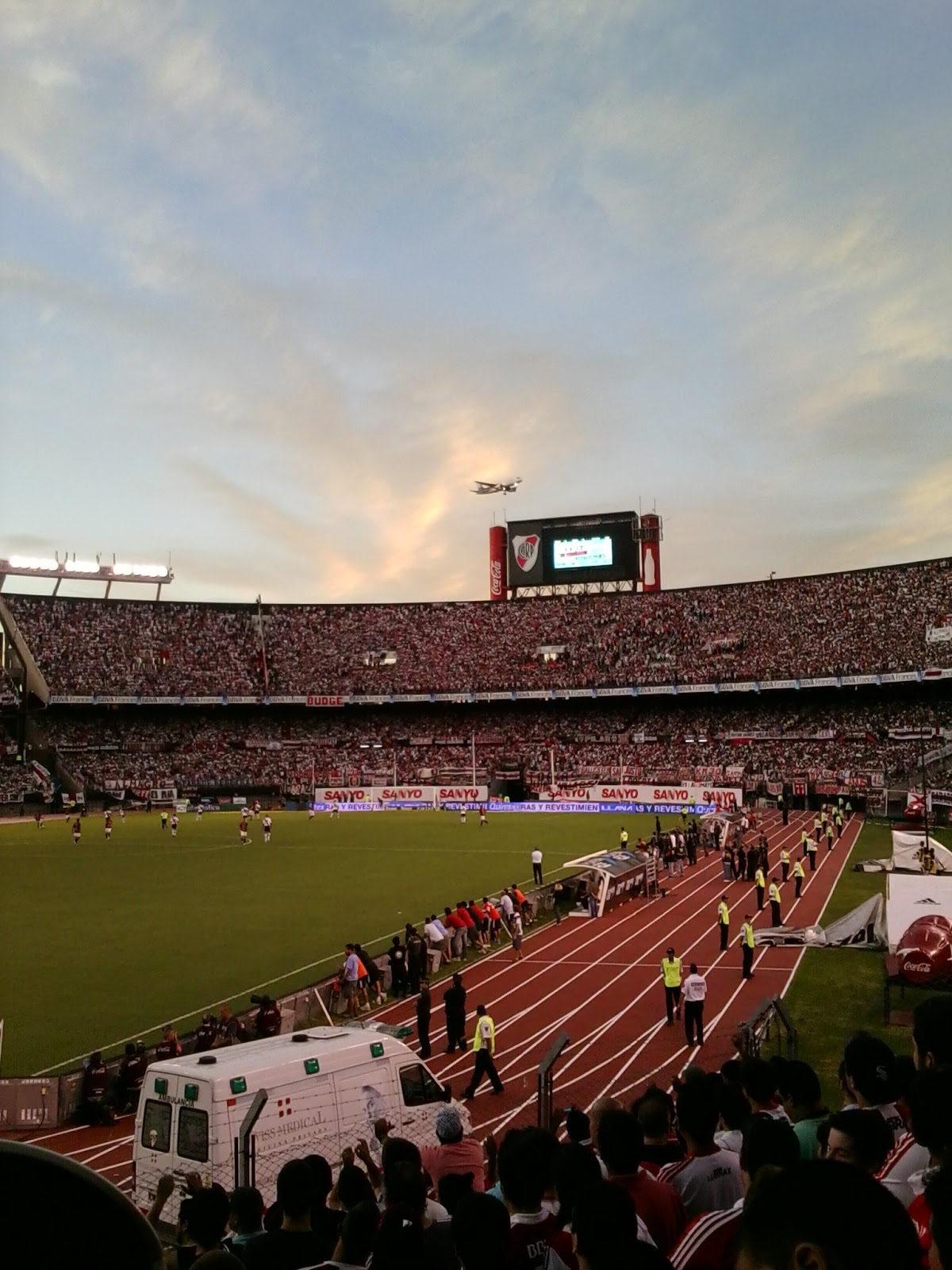
A beautiful night at the Monumental. Soccer, sunset, and planes landing at the airport nearby.

Before the game even began, as the starting players were waiting on the field for the whistle to blow, the fans began to sing, led by the drums and chants of the barra in the upper deck at the far end of the stadium below the scoreboard. I can't even begin to describe how awesome it is to be among more than 60,000 people all dressed in River's red and white, singing, clapping, and yelling for almost the entire 90 minutes of the match. The only time the crowd was quiet was for a couple of brief seconds when the away team, Colón of Santa Fe, cut River's two-goal lead in half with about fifteen minutes to go. But after that brief silence, the crowd began to sing even louder, urging on its beloved team for the rest of the match. At the end, after the referee had blown the final whistle, the crowd began to sing even louder than before, especially as the players made their way around the field applauding the fans for their support. The home fans then had to wait about a half hour until all of the visiting supporters had left the stadium and had been loaded onto the buses for the long drive back to Santa Fe. In order to avoid the mass exodus of fans via public transport immediately after the game, we went to the cafeteria to sit with the girls on the team who had to eat dinner at the club. It worked out perfectly because by the time they finished, the majority of fans had already cleared out and we had no problem getting on the subway to go home.

Needless to say, it was an amazing evening, and I'm definitely going to all the home games that I can make it to. Also, any of my friends who come to visit me will also be highly encouraged to come with me to a match. It is an unforgettable experience that is unique to soccer in Argentina and so unbelievably different from sporting events in the United States (in both positive and negative ways).

Monday, March 4, 2013

Love and soccer


Going by my last post, I'm concerned I might have come across overly negative towards women's soccer in Argentina, which would be a very unfair assessment. Unfair not only to all of the girls and women who play but also unfair to all of the coaches, administrators, equipment managers, doctors, etc who donate their time and efforts to women's teams throughout the nation. While there are certainly aspects of Argentine women's soccer that I would love to improve, there are so many more things that I love about playing here that I never experienced during my time playing in the United States.

Team picture in River Plate's Stadium, El Monumental

I love how every time our team gets together, whether it's for training, a game, a trip, or a meal, we always greet and say goodbye to each teammate individually with a kiss on the cheek. Granted, it does take time to go around the locker room and say hello to every single person in there, especially when I'm the last one to arrive, but it is amazing how a simple greeting has made me feel welcome among a group of people I hardly know. In the United States, when I would come to team events, I would usually just say hello to the group in general and maybe give a hug to a few of my closer friends, and only if I had not seen them in a while. To an American, greeting someone with a kiss on the cheek can seem overly intimate, especially when we are so accustomed to handshakes, but I think a kiss breaks down relational barriers in a way a handshake cannot and allows for friendships to grow more quickly and on a deeper level (but I may be overanalyzing the situation...).

I love how much each player loves fútbol. Many are willing to spend 3 hours or more traveling just to train for 2. (I know I've mentioned this before, but it still amazes me when I talk to the girls about their commute.) There is nothing forcing them to continue playing, no monetary benefits, no pressure from family, no fancy sporting gear, just love. Love for the game. Love for her team. Love for her coaches, her club, her country. Although I loved soccer before, since joining River, my love for the game itself has really been reignited. In college I often found myself dreading practices, games, and weight training because I always felt a huge amount of pressure from coaches to perform. Winning was always the goal, no matter what the cost, whether it meant sacrificing relationships, stirring up competitive strife between teammates, or even ignoring players entirely. And if that wasn't the case, then it is certainly the impression I came away with after playing at two different universities under three different head coaches. Obviously, winning is still important in Argentina, and the ultimate goal is to get results on the field – but not at all costs. The coaches and staff at River strive to make us not only better players but better people. Because, in the end, soccer is a game that we can only play for a relatively short part of our lives, but the lessons of teamwork, relationships, hard-work, commitment, etc that we learn from the sport will stay with us in whatever we do for the rest of our lives.

I love how everybody shares everything with everyone. Whenever somebody buys a drink or a snack and is around the team, before even taking a sip or a bite, the first thing she does is offer it to the girls who are standing nearby. This was something that took a little getting used to for me – I'm not going to lie. To be honest, I'm still adjusting to the whole sharing-your-water-with-everybody-thing. I would not consider myself a "germophobe" per-se, but enough so to where I'm slightly wary of drinking from the same bottle as 20 other girls. Granted, one usually only shares with a few others, but still the idea is one that takes some getting used to. Nonetheless, as a new member of the team, one cannot help but feel welcomed and accepted when a teammate offers to share her snack. It's a small gesture that goes a long way.

I could go on about what I love about playing here, but I think I can help sum it up by telling about our team's trip last weekend (Feb. 23-24), which I will describe in my next post since this is one is quickly getting too long...